
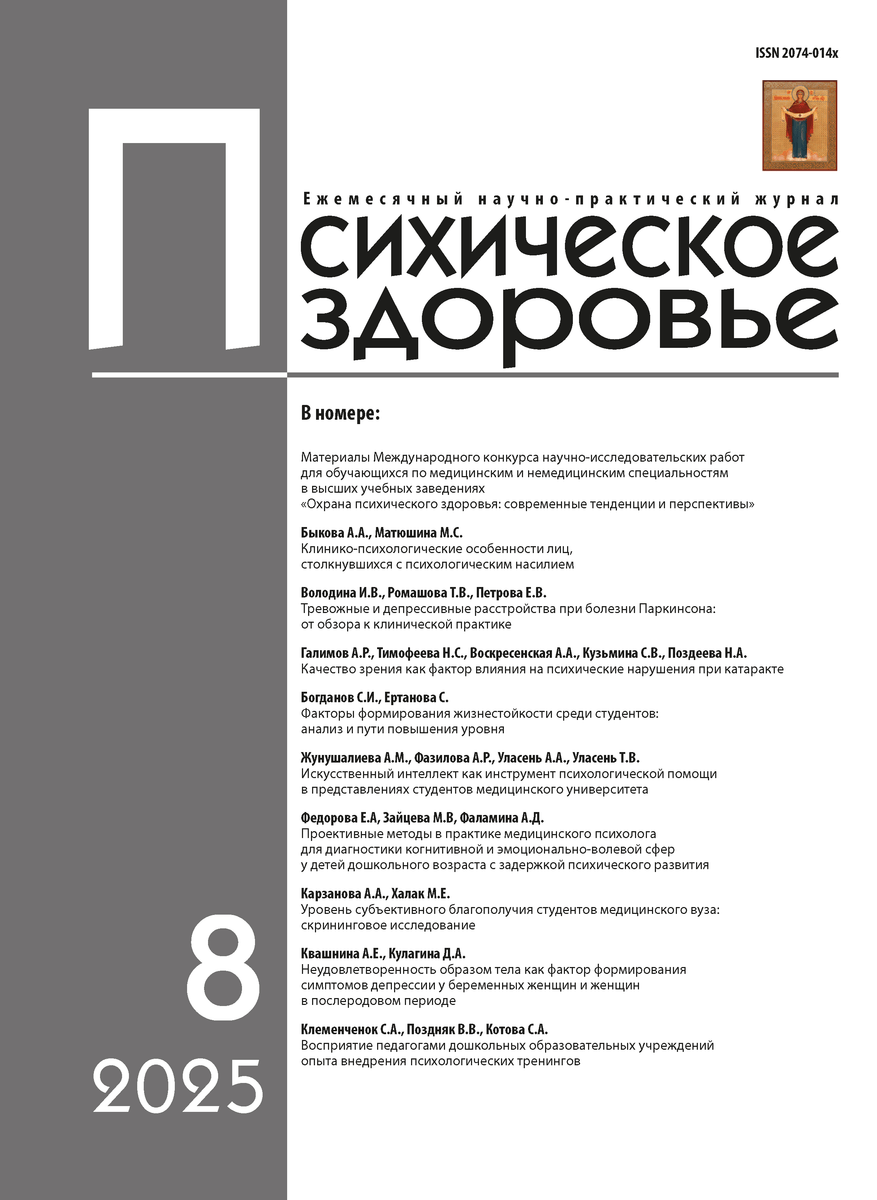
Published issue
Mental Health. 2025; Volume 20. Issue 8
- Volume
- 20
- Articles
- 9
- Archive format
- Bibliographic information
Full-text articles and issue PDFs are not hosted on this website.
Issue contents
Contents
По материалам научных конференций
Clinical and psychological characteristics of persons faced with psychological violence
- Smolensk State Medical University
Abstract
Introduction. Psychological violence is a form of aggression that can be hidden and unnoticeable, but at the same time leaves deep wounds in the human soul. This is a type of violence based on humiliation, threats, isolation, manipulation and other harmful actions aimed at suppressing the personality of another person. It can lead to serious consequences for a person’s mental and emotional health. Victims of such exposure may experience constant stress, anxiety, feelings of helplessness and unworthiness. They may lose self-confidence, become isolated from others and lose interest in life. Psychological violence can lead to the development of depression, anxiety disorders, post-traumatic stress disorder and other mental problems, which is why the study of this phenomenon is so relevant.
Methods. A study of a sample of students of the Federal State Budgetary Institution of Higher Education «Smolensk State Medical University» of the Ministry of Health of the Russian Federation aged 18-21 years was conducted. The average age of the respondents was (20.745±0.265) years. The following research methods and techniques were used in the work: questionnaires to determine the presence of psychological violence, parental prescriptions, coping strategies and individual personality characteristics. The statistical analysis was carried out using the licensed Statistica 10 software from StatSoft.
Results. It has been established that persons who have faced psychological violence are characterized by such personal characteristics as decreased emotional stability, increased anxiety, decreased self-control and a tendency to tension. Also, respondents are dominated by such coping behaviors as de-responsibility, reassessment and confrontation, which implies a certain degree of hostility and willingness to take risks or avoid them. We can see in such people the appropriation of irrational parental messages: don’t be, don’t be meaningful, don’t feel, don’t be normal.
Conclusion. The specifics of family introjects and the impact of psychological violence at an early age act as prerequisites for the formation of irrational coping behaviors, as well as individual psychological characteristics of a personality.
Keywords: psychological violence, introjects, parental prescriptions and attitudes, coping behavior
For citation: Bykova A.A., Matyushina M.S. Clinical and psychological characteristics of persons faced with psychological violence. Psikhicheskoe zdorovie [Mental Health]. 2025; 20(8): 4-10. (In Russian).
Anxiety and depressive disorders in Parkinson’s disease: from review to clinical practice
- Penza State University
Abstract
Introduction. Parkinson’s disease (PD) is a common neurodegenerative disorder characterized by progressive loss of dopamine neurons. With the aging population, PD is becoming a significant public health problem. In addition to motor symptoms, non-motor symptoms such as anxiety and depression, which often remain unrecognized, have a significant impact on quality of life. This paper summarizes current data on the prevalence, pathogenesis, clinical features, and treatment of anxiety and depressive disorders in PD.
Methods. A search and analysis of publications in PubMed, Web of Science, Scopus and RINTS (2015-2024) was conducted using keywords related to Parkinson’s disease, anxiety and depression. A retrospective analysis of a clinical case with an assessment of the patient’s condition using clinical and psychometric methods (HADS, MMSE, MoCA, PDQ-39) in dynamics during therapy is presented. Informed consent was obtained.
Results. The review demonstrated the high prevalence of psychoemotional disorders in PD: the frequency of anxiety disorders reaches 50%, depression – 60%. Pathogenetic mechanisms are complex, including neurochemical and psychosocial factors. Anxiety aggravates motor symptoms and is associated with fluctuations in dopamine levels. The clinical picture of depression in PD may differ, manifested by apathy and anhedonia, in contrast to «classic» depression. Diagnosis is based on clinical criteria and special psychometric scales. Timely diagnosis and optimization of therapy are important. The presented clinical case demonstrates the complexity of managing a patient with PD and comorbid anxiety-depressive disorder, which requires an integrated approach. The addition of duloxetine to antiparkinsonian therapy showed a reasonable therapeutic effect, which will be assessed in the long term by PDQ-39.
Conclusions. The obtained data emphasize the clinical significance of anxiety and depression as common comorbid conditions in PD, significantly affecting the quality of life. Optimization of therapeutic strategies based on comprehensive diagnostics and a personalized approach to the choice of pharmacological and non-pharmacological methods is a key factor in improving outcomes. Further research is needed to clarify the role of specific neurobiological mechanisms and develop more effective personalized treatment regimens for anxiety and depressive disorders in PD.
Keywords: Parkinson’s disease, anxiety, depression, psycho-emotional disorders, diagnostics, therapy
For citation: Volodina I.V., Romashova T.V., Petrova E.V. Anxiety and depressive disorders in Parkinson’s disease: from review to clinical practice. Psikhicheskoe zdorovie [Mental Health]. 2025; 20(8): 11-21.
Vision quality as factor influencing mental disorders associated with cataract
- Kazan State Medical UniversityKazan, Russia
- Cheboksary branch of the S. Fyodorov Eye Microsurgery Federal State InstitutionCheboksary, Russia
- Postgraduate Doctors Training Institute of the Ministry of Public Health of ChuvashiaCheboksary, Russia
Abstract
Introduction. Cataract is one of the most common causes of vision loss or decline worldwide. Contemporary research found an increased risk of developing mental disorders among patients with cataract. It is worthwhile to search for possible factors determining the mechanism of negative impact of cataract on mental health of the patient. Quality of vision can be considered one of these factors.
Objective. To perform the literature review on the relationship of vision quality and mental disorders observed among the patients with cataract.
Methods. We conducted an analytical review of literary sources for the period 1990-2025 published in databases in PubMed and eLibrary. The following keywords were used as search queries: «cataract», «mental disorders», «cognitive impairment», «dementia», «depression», «visual acuity», «vision quality».
Results. The available data on the impact of visual quality on mental health is contradictory. A number of studies do not find statistically significant correlation between visual acuity (VA) and mental disorders associated with cataract after adjustment for confounding factors. Some authors claim that relationship between VA and mental disorders is mediated by subjective quality of vision (SQV) reflecting a decrease in the patient’s capability to perform vision-dependent tasks. SQV is stronger related to the dynamics of the patient’s mental status regardless of underlying eye disease, however, it may be subject to influence by the general negative mental state of the patient due to the factors independent of vision. Longitudinal studies, which confirm the relationship between VA and mental disorders, find such correlation for depressive symptoms only.
Conclusion. The results of the review of the research publications do not support the conclusion that quality of vision plays defining role for development of mental disorders associated by cataract. The relationship between cataract and adverse psychiatric symptoms in cataract patients may be explained by number of causes including visual, psychosocial, neurophysiological and general health factors.
Keywords: cataract, mental disorders, mental health, visual impairment, visual acuity, vision quality
For citation: Galimov A.R., Timofeeva N.S., Voskresenskaya A.A., Kuzmina S.V., Pozdeyeva N.A. Vision quality as factor influencing mental disorders associated with cataract. Psikhicheskoe zdorovie [Mental Health]. 2025; 20(8): 22-29.
Factors influencing resilience among students: an analysis and recommendations for enhancing levels
- Ural State Medical University
Abstract
Introduction. The issue of resilience as a psychological phenomenon is becoming particularly important in modern conditions, where there is an increasing need to find effective strategies to counter the growing external influences. These factors have a significant impact on the comprehensive personal development, especially of students. The issue of resilience is becoming a key quality that determines the ability to successfully adapt and thrive in a dynamically changing environment.
Aim: to identify the influence of socio-demographic factors and the use of surfactants on the resilience of university students.
Methods. The study involved 526 students from various universities in Yekaterinburg. The research tool is the Maddi resilience test (Authors: Salvatore Maddi, D. Khoshaba, 1984, 2001. Adaptation: D. A. Leontiev, E. I. Rasskazova, 2006). The resilience test is an adaptation by D.A. Leontiev of the Hardiness Survey questionnaire developed by the American psychologist Salvatore Maddi. The statistical analysis was carried out using the statistical software package SPSS Statistics.
Results. The distribution of respondents by gender: women – 67%, men – 33%. The average age was 20.9 years (min – 17, max – 36, SD=2.78). Higher values of the level of resilience in females prevail. The average level of resilience prevails with an average score of 69.7 points (n= 320). The hypothesis about the possible influence of alcohol and/or drug addiction on the level of resilience has been confirmed.
Discussion. The period of the respondents’ life path occurred during their student days, which led to the variability of the influence of socio-demographic factors on the level of resilience. We were able to find confirmation of the hypothesis about the possible influence of alcohol and/or drug addiction on the level of resilience among students in Yekaterinburg.
Conclusion. Our research and literature review highlights the need to expand the Muddy system in the study of resilience. The higher level of resilience among students of alcohol and/or drug addictions demonstrates the need for further research and promotion of this field of science.
Keywords: resilience, students, addiction, alcohol and drug use
For citation: Bogdanov S.I., Yertanova S. Factors influencing resilience among students: an analysis and recommendations for enhancing levels. Psikhicheskoe zdorovie [Mental Health]. 2025; 20(8): 30-35. (In Russian).
Artificial intelligence as a psychological aid tool in the ideas of medical university students
- Smolensk State Medical UniversitySmolensk, Russia
- St. Petersburg State Electrotechnical University «LETI» named after V.I. Ulyanov (Lenin)St. Petersburg, Russia
Abstract
Introduction. The rapid development of artificial intelligence technologies is currently leading to the emergence of new tools in various fields, including psychology. At the same time, chatbots are beginning to appear as alternative options for psychological assistance.
Aim: to describe the ideas of 1st-year students of the medical University about virtual psychological bots and, based on them, generate appropriate images using artificial intelligence.
Results. 331 1st-year students of Smolensk State Medical University aged 18-19 years took part in the survey. Of these, 101 are students of the specialty «medical science»; 89 are students of the specialty «pediatrics»; 111 are students (English-speaking) of the Faculty of Foreign Students; 30 students represented the Faculty of Psychology and Social Sciences. The results show differences in the perceptions of students of different faculties in the perception of the image of a virtual psychologist, its functionality, limitations and ethical aspects of the application of psychology in the digital space.
Conclusions. The contribution of bot psychologists, according to students, may be to help formulate a request for further consultation with a professional psychologist and referral to appropriate specialists. But qualified and effective psychological assistance is primarily the activity of a professional psychologist who possesses a range of special theoretical knowledge (including medical, psychological, social, physiological and age-related aspects of norm and pathology, psychogenesis) and practical skills acquired as a result of special training and work experience.
Keywords: virtual psychologist-bot, students’ ideas about the image of a virtual psychologist-bot, psychological help
For citation: Zhunushalieva A.M., Fazilova A.R., Ulasen A.A., Ulasen T.V. Artificial intelligence as a psychological aid tool in the ideas of medical university students. Psikhicheskoe zdorovie [Mental Health]. 2025; 20(8): 36-42.
Projective methods in the practice of a medical psychologist for the diagnosis of cognitive and emotional-volitional characteristics in preschool children with mental retardation
- Smolensk State Medical University
Abstract
Introduction. Projective diagnostic methods, unlike tests and questionnaires, make it possible to comprehensively study the mental development of a child, and especially a preschool child with ASD, since even a child without mental development disorders cannot yet answer the questions asked in written self-reports. In addition, projective methods do not take up much time for diagnosis, are interesting for children and allow them to determine the diagnostic parameters of a child in normal and impaired speech development and communication difficulties.
Aim. To identify the features of the use of projective methods in the practice of a medical psychologist for the diagnosis of cognitive and emotional-volitional spheres in preschool children with mental retardation.
Methods. The study involved 26 preschool children with ASD, who made up the main group, which was divided into two subgroups: children with ASD, whose main disorder was delayed speech development (F 80.82), and the other subgroup consisted of children with ASD with autism spectrum disorders (F84.0, 84.1). The control group included 18 children with normal mental development. The average age of the children was 6.5 years. To achieve this goal, a psychographic test was used in the work: A constructive drawing of a human (tiger) The Libins and the «Draw Yourself» technique, Clinical Lusher color test. The statistical analysis was carried out using the computer program «Statistica 12.0».
Conclusions. The use of projective tests allows for a comprehensive psychological diagnosis of the cognitive and emotional-volitional spheres of preschool children with ASD and a detailed assessment of the mental development of children with speech disorders and autism spectrum disorders.
Keywords: projective methods, preschool children, mental retardation, delayed speech development, autism spectrum disorders
For citation: Fedorova E.A., Zaitseva M.V., Falamina A.D. Projective methods in the practice of a medical psychologist for the diagnosis of cognitive and emotional-volitional spheres in preschool children with mental retardation. Psikhicheskoe zdorovie [Mental Health]. 2025; 20(8): 43-51.
Subjective well-being level of medical students: a screening study
- Privolzhsky Research Medical University
Abstract
Introduction. Subjective well-being (hereinafter – SWB) is an integrative indicator that reflects a person’s cognitive assessment of his life or life satisfaction and affective balance, when positive emotions prevail over negative ones. In the context of medical education, subjective well-being becomes critically important, since studying at medical universities is associated with unique stressors that affect the psychological state of students. In this study, the authors present the results of a screening assessment of the level of subjective well-being of students.
Methods. The screening was conducted in February-March 2025 among students of all faculties of PRMU, as well as residents of the 1st and 2nd years of study. To assess the level of SWB, the «Scale of Subjective Well-Being» by A. Perue-Badu was used (adaptation by M.V. Sokolova).
Results. The study involved 985 students, 83% of whom were women and 17% were men. The overall level of social well-being of students at PRMU is moderate in 91% of cases, 8% of respondents note a comfortable level, and 1% describe their well-being as complete.
Discussion. The study revealed a tendency for a slight decrease in the level of subjective well-being of students as the course of study increases, but in the sixth year the overall level increases sharply (the results go from 5th in the 5th year to 4th in the 6th). At the same time, residents again show a slight tendency for a decrease in subjective well-being (the indicators tend to cluster 5).
Conclusion. The obtained data are consistent with global studies, confirming the high vulnerability of medical students. The SBW`s level of medical students is a complex problem that requires an interdisciplinary approach and systemic attention from educational institutions. Stress prevention and the development of resource states should become part of the training of future doctors to ensure not only their professional growth, but also psychological stability.
Keywords: subjective well-being, students, learners, level of life satisfaction
For citation: Karzanova A.A., Khalak M.E. Subjective well-being level of medical students: a screening study. Psikhicheskoe zdorovie [Mental Health] 2025; 20(8): 52-57. (In Russian).
Body image dissatisfaction as a factor in the development of depressive symptoms in pregnant and postpartum women
- Altai State University
Abstract
Introduction. The perinatal period is accompanied by significant physiological and psychological changes that may lead to body image dissatisfaction and depressive states. This study aims to examine the relationship between body dissatisfaction and depression in pregnant and postpartum women.
Methods. The study included 112 women, 62 of whom were pregnant, while 50 were in the postpartum period (up to one year after childbirth). The following diagnostic tools were used: the «Body Image Questionnaire» (BIQ), the «SIBID» method, and the Beck Depression Inventory. Pearson’s correlation analysis and Student’s t-test were applied for data analysis.
Results. A statistically significant positive correlation was found between body dissatisfaction and depression levels in both pregnant women (r = 0.614, p = 0.000 for situational dissatisfaction; r = 0.569, p = 0.000 for general dissatisfaction) and postpartum women (r = 0.520, p = 0.000 and r = 0.500, p = 0.000, respectively). Additionally, postpartum women exhibited higher levels of depressive symptoms than pregnant women (M = 14.180 vs. M = 10.064, t = -2.68, p = 0.008), as well as higher body dissatisfaction (M = 6.360 vs. M = 4.983, t = -2.88, p = 0.005). Situational body dissatisfaction was also more pronounced in postpartum women (M = 1.632 vs. M = 1.113, t = -2.72, p = 0.007). These findings confirm that the postpartum period is characterized by greater body dissatisfaction and more pronounced depressive symptoms.
Discussion. The results support the hypothesis of an association between body image dissatisfaction and depression levels in pregnant and postpartum women. Women in the postpartum period are particularly vulnerable to negative body image due to physical changes and societal pressures.
Conclusion. The findings highlight the need for psychological support for women during pregnancy and after childbirth. Intervention programs should include components aimed at promoting a positive body image and reducing anxiety about appearance.
Keywords: pregnancy, postpartum period, body image dissatisfaction, depression
For citation: Kvashnina A.E., Kulagina D.A. Body image dissatisfaction as a factor in the development of depressive symptoms in pregnant and postpartum women. Psikhicheskoe zdorovie [Mental Health]. 2025; 20(8): 58-62.
Perception of preschool educators regarding the implementation of psychological trainings
- Pre-school educational institution No. 93Saint-Petersburg, Russia
- A.I. Herzen Russian State Pedagogical UniversitySaint-Petersburg, Russia
- Leningrad Regional Institute of Education DevelopmentSaint Petersburg, Russia
Abstract
The article presents a study on the perception of preschool educational institution (PEI) educators regarding the implementation of psychological trainings for staff. The aim of the study was to assess educators’ attitudes toward these practices, identify key challenges in their integration, and analyze the subjective effectiveness of the trainings. The research was conducted at GBDОU № 93 in the Vyborgsky District of Saint Petersburg, involving 26 educators. A semi-standardized survey method was employed to examine respondents’ years of service, their attitudes toward trainings, and the impact of these trainings on their professional activities and team communication.
Keywords: training, working with a team, preschool education, preschool teacher
For citation: Klemencheonok S.A., Pozdnyak V.V., Kotova S.A. Perception of preschool educators regarding the implementation of psychological trainings. Psikhicheskoe zdorovie [Mental Health]. 2025; 20(8): 63-68.