
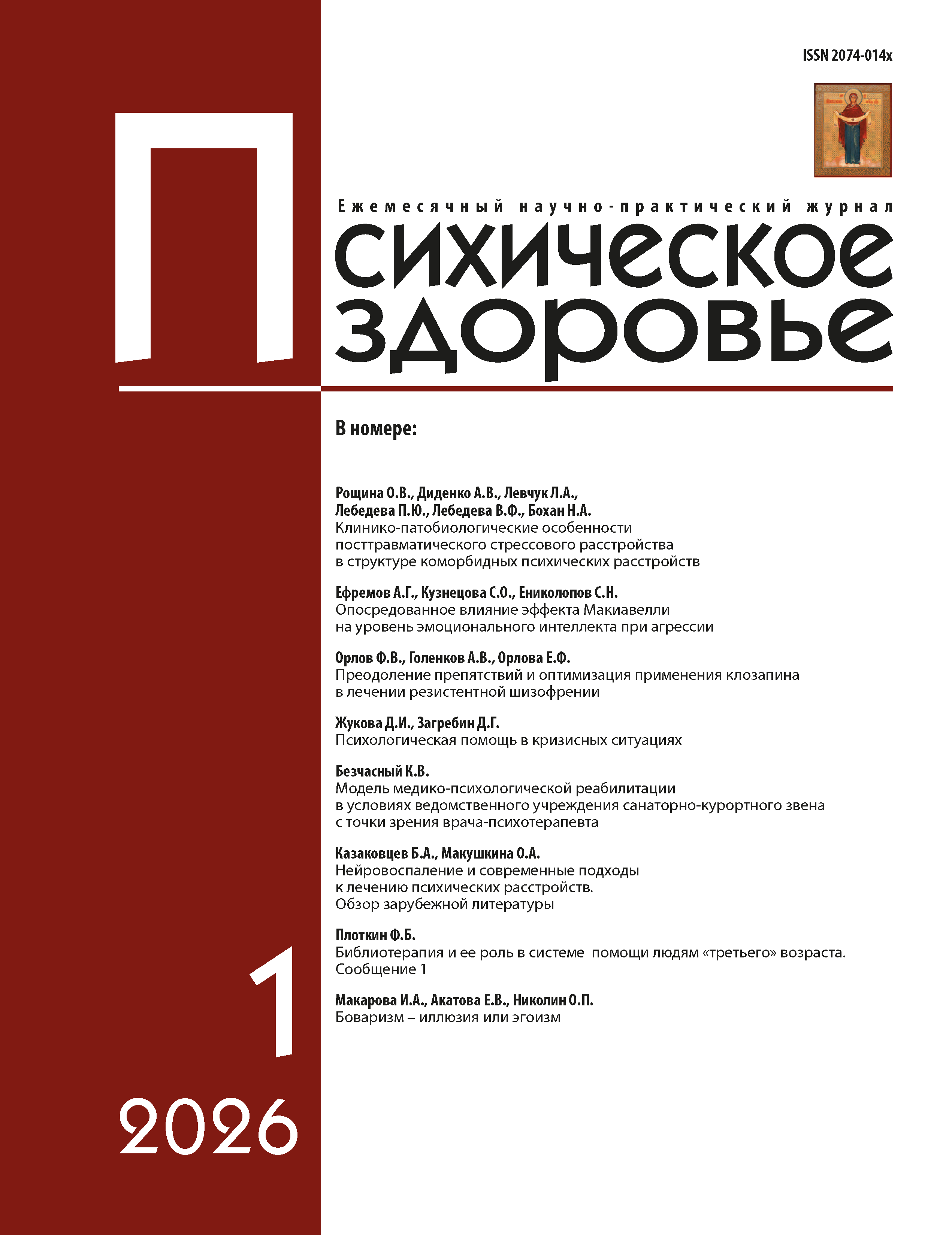
Published issue
Mental Health. 2026; Volume 21. Issue 1
- Volume
- 21
- Articles
- 8
- Archive format
- Bibliographic information
Full-text articles and issue PDFs are not hosted on this website.
Issue contents
Contents
Clinical practice. Diagnosis. Treatment
Clinical and pathobiological features of Post-traumatic Stress Disorder in the structure of comorbid mental disorders
- Mental Health Research Institute, Tomsk National Research Medical Center, Russian Academy of SciencesAleutskaya Street 4, 634014, Tomsk, Russian Federation
- Siberian State Medical University of the Ministry of Health of the Russian FederationMoskovsky Trakt 2, 634050, Tomsk, Russian Federation
Abstract
Introduction. Post-traumatic stress disorder (PTSD) and other stress-related disorders are a complex interdisciplinary problem at the intersection of medicine, psychology, neurobiology and sociology that requires special attention due to its high comorbidity with other mental disorders. This creates difficulties in diagnosis and treatment, and negatively affects the social adaptation of patients. An important task is to develop effective screening methods for PTSD, especially in cases of its combination with other disorders, for the timely initiation of personalized therapy.
Objective. To study the features of the clinical and pathobiological course of comorbidity of PTSD and other mental disorders in people who have suffered combat stress, including the assessment of clinical and anamnestic characteristics, the effectiveness of diagnostic tools and biochemical markers of distress.
Methods. 40 patients (men 18-60 years old) of the Tomsk Scientific Research Institute of Mental Health, who participated in the fighting. Methodology: clinical and anamnestic examination, CES scales and the Mississippi PTSD scale, determination of serum cortisol levels, statistical analysis using IBM SPSS Statistics 25.
Results. 2 groups were identified — patients without PTSD (n=17) and with comorbid PTSD (n=23). There was no association between the severity of symptoms and the intensity of traumatic experience (p>0.05, chi-squared, Mann-Whitney), a statistically significant relative increase in cortisol levels in the group with PTSD (p=0.041, Mann-Whitney), and the high effectiveness of the Mississippi PTSD Scale as a screening tool (p=0.005, Mann-WhitneyWhitney).
Conclusion. The study demonstrates the complexity of the pathogenesis of PTSD and its high comorbidity with other mental disorders. Increased cortisol levels may serve as a potential biomarker of stress-related disorders. The results highlight the need for a comprehensive approach to the diagnosis and treatment of PTSD in survivors of combat stress.
Keywords: PTSD, comorbidity, cortisol, Mississippi scale of PTSD
For citation: Roschina O.V., Didenko A.V., Levchuk L.A., Lebedeva P.Yu., Lebedeva V.F., Bokhan N.A. Clinical and pathobiological features of Post-traumatic Stress Disorder in the structure of comorbid mental disorders. Mental Health [Psikhicheskoe zdorovie]. 2026; 21(1): 3-9. (In Russian).
Indirect influence of Machiavelli effect on the level of emotional intelligence during aggression
- Mental Health Research Center
Abstract
The present study examines a non-physical type of aggression, when harm is caused to interpersonal interactions and/or the social status of the victim without causing physical harm on the part of the aggressor. This type of aggression is quite common among adolescents and young adults. The study involved 713 Russian-speaking young men and women in their late teens and early adulthood. The aim of the study was to identify possible links between emotional intelligence and interpersonal aggression, as well as to assess the Machiavellian effect mediating aggression. The methodological set included the following methods: the Machiavellianism scale from the Dark Dozen method, the EmIn questionnaire by D.V. Lyusin, and the scales of the method by A. Bass and A. Darki. Statistical programs of the SPSS 25.0 package were used to analyze the reliability, validity and general error of the measurement methods. As a result of the study, a statistically significant inverse relationship was established between the level of emotional intelligence and the degree of interpersonal aggression, and it was also revealed that the Machiavelli effect is able to reduce the degree of these relationships. At the same time, regardless of the degree of the Machiavelli effect, the level of emotional intelligence is inversely related to the degree of aggression. That is, a high level of emotional intelligence will correspond to a low probability of aggression. This study was focused on the relationship between emotional intelligence and non-physical aggression and set itself the task of finding a justification for further development of the direction of work on the correction of adolescent aggression based on the obtained results. The obtained results provide a new understanding of possible strategies of influence aimed at reducing adolescent aggression by increasing the level of emotional intelligence.
Keywords: emotional intelligence, Machiavellian effect, teenagers, aggression, non-physical aggression
For citation: Efremov A.G., Kuznetsova S.O., Enikolopov S.N. Indirect influence of Machiavelli effect on the level of emotional intelligence during aggression. Mental Health [Psikhicheskoe zdorovie]. 2026; 21(1): 10-19. (In Russian).
Overcoming obstacles and optimizing the use of Clozapine in the treatment of resistant schizophrenia
- Chuvash State UniversityCheboksary, Russia
- Institute for Advanced Training of PhysiciansCheboksary, Russia
Abstract
Clozapine remains the only officially approved effective drug for the treatment of therapy-resistant schizophrenia. However, it is rarely prescribed due to fears of life-threatening complications and side effects. The reason for the rare appointment is the need for mandatory blood monitoring, as well as insufficient awareness of the drug among doctors and limited experience in its use. Many doctors are not well informed about improving the effectiveness of clozapine therapy, minimizing side effects, and overcoming resistance to treatment.
The key aspects of successful clozapine treatment are individual dose selection for each patient. Early inclusion of the drug in the treatment of schizophrenia helps to reduce the risk of resistance. The prevention of clozapine resistance using therapy enhancement measures is promising. In the early stages of treatment, psychosocial measures, psychotherapy, and emotional and practical assistance should be applied. Sufficient duration of treatment and strict monitoring of medication intake will help reduce the risk of discontinuation of treatment and relapse of psychosis. It is important to eliminate possible barriers to prescribing clozapine from doctors, establish cooperation with patients and caregivers, and resolve organizational issues of prescribing the drug in a medical facility.
Keywords: schizophrenia, resistance, treatment, clozapine, efficacy
For citation: Orlov F.V., Golenkov A.V., Orlova E.F. Overcoming obstacles and optimizing the use of Clozapine in the treatment of resistant schizophrenia. Psikhicheskoe zdorovie [Mental Health]. 2026; 21(1): 20-25. (In Russian).
Medical and social aspects
Psychological assistance in crisis situations
- St. Petersburg University of the Ministry of Internal Affairs of RussiaSt. Petersburg, Russian Federation
- I.I. Mechnikov North-Western State Medical UniversitySt. Petersburg, Russian Federation
- Saint Petersburg Medical and Social InstituteSaint Petersburg, Russian Federation
- Academy of Management of the Ministry of Internal Affairs of RussiaMoscow, Russian Federation
Abstract
Introduction. This review article examines the features of psychological assistance in crisis situations.
Methods. Theoretical analysis of psychological models of crisis and crisis intervention, comparison with clinical data and empirical research.
Results. The principles of crisis intervention are defined: the crisis assistance program as a model for solving problems; the scheme of intervention during a crisis; concepts of crisis intervention related to events and concepts of stress coping; methods of crisis psychotherapy; signs of the social environment as moderators of stress.
Discussion. The following types of crisis assistance are described: crisis psychotherapy, hotlines, psychological support groups, support groups for somatic patients, crisis assistance for terminally ill patients, crisis assistance for suicide-prone people, crisis assistance for migrants, crisis assistance for losses and pathological grief work.
Conclusion. Emergency psychological assistance to a person in a state of crisis includes leading methods of crisis psychotherapy and crisis counselling. The patterns and mechanisms of human response to crisis events, methods of coping with them are effective in the work of psychologists and all those who work with people who have suffered mental trauma.
Keywords: crisis, crisis intervention, crisis psychology, crisis psychotherapy
For citation: Zhukova D.I., Zagrebin D.G. Psychological assistance in crisis situations. Mental Health [Psikhicheskoe zdorovie]. 2026; 21(1): 26-36. (In Russian).
Brief report
A model of medical and psychological rehabilitation in a departmental health resort facility from the point of view of a psychotherapist
- Medical Department of the Ministry of Internal Affairs of Russia across Moscow
Abstract
The article proposes to consider and possibly implement a set of medical and psychological measures for police officers, which will serve to increase their professional reliability. The focus is on people suffering from borderline mental pathology and a key place is given to psychotherapeutic and psychoprophylactic measures.
Keywords: police officers, psychotherapy, psychoprophylaxis, rehabilitation
For citation: Bezchasniy K.V. A model of medical and psychological rehabilitation in a departmental health resort facility from the point of view of a psychotherapist. Mental Health [Psikhicheskoe zdorovie]. 2026; 21(1): 37-41. (In Russian).
Review
Neuroinflammation and modern approaches to the treatment of mental disorders. Review of foreign literature
- V.P. Serbsky National Medical Research Centre for Psychiatry and Narcology
Abstract
The present literature review examines shared and disorder-specific mechanisms underlying mental disorders, with particular emphasis on neuroinflammation, dysregulation of autophagy, disruption of the blood–brain barrier, and cognitive impairment. It highlights that the future potential of personalized medicine is grounded in the integration of genetic data, neuroimaging findings, and biomarker profiles, and that a deeper understanding of the pathophysiological interrelationships among disorders may facilitate interdisciplinary treatment approaches and lead to improved clinical outcomes.
Keywords: neuroinflammation, therapeutic approaches, personalized medicine in mental health services
For citation: Kazakovtsev B.A., Makushkina O.A. Neuroinflammation and modern approaches to the treatment of mental disorders. Review of foreign literature. Mental Health [Psikhicheskoe zdorovie]. 2026; 21(1): 42-54. (In Russian).
Discussion forum
Bibliotherapy and its role in the system of assistance to people of the «third» age. Part 1
- Minsk City Clinical Narcological Center
Abstract
The article points to a significant increase in human life expectancy compared to previous periods of history, which leads to an increase in the number of elderly people experiencing numerous problems both in society in general and in interpersonal relationships. The need to provide them with psychological and psychotherapeutic assistance is emphasized. Attention is drawn to the objective and subjective obstacles to the use of psychotherapeutic methods with the relative availability of bibliotherapy. Language and writing have been defined as distinguished signes of homo sapiens. Book reading has been determined as superimportant means for world cognition and personality forming. Getting used to reading necessity in young age has been emphasized. Mass media and technical means of communication negative effect on intra-personal relations has been described. Literature and personality intra- relations within Russian language space have been shown. Such relations negative tendencies in post soviet states have been characterized. Some thinkers statements on reading meaning have been cited. Phisiological and psychological word and reading effect has been shownBibliography as science and practice definitions have been presented and its position among other humanitarian disciplines has been stated. Bibliotherapy multilateral effect on personality in norm and pathology has been shown. Bibliotherapy modern state abroad as well as on post-soviet space has been estimated. Some approaches to conducting bibliotherapy for elderly people are described.
Keywords: life expectancy, elderly people, language, writing, book, literature, reading, language, writing, book, literature, reading, bibliotherapy
For citation: Plotkin F.B. Bibliotherapy and its role in the system of assistance to people of the «third» age. Part 1. Mental Health [Psikhicheskoe zdorovie]. 2026; 21(1): 55-63. (In Russian).
Bovarism — illusion or egoism
- Russian University of Medicine
Abstract
Introduction. The phenomenon of «bovarism,» first described in the late 19th century, is a distinct psychological condition characterized by a gap between imaginary expectations and reality. It manifests itself in the loss of the ability to adequately perceive reality, the substitution of fantasy constructs for real relationships, and chronic emotional dissatisfaction.
Objective: to analyze the phenomenon of bovarism as a form of psychological and behavioral maladjustment, identify its connection with an egoistic worldview, and compare it with the related concept of «quixotism» using literary and philosophical sources.
Methods. An interdisciplinary analytical approach was used, incorporating literary, psychological, and philosophical analysis of the works of Gustave Flaubert, Leo Tolstoy, and Maximilian de Cervantes, as well as works in clinical and practical psychology.
Results. It has been shown that bovarism is characterized by the idealization of love, an inability to form stable interpersonal relationships, persistent dissatisfaction, and a tendency toward an egocentric worldview. It has been established that bovarism and quixotism reflect similar mechanisms of escaping reality and replacing achievable goals with illusory ones.
Conclusion. Bovarism should be viewed as a persistent psychocultural phenomenon associated with impaired emotional regulation, distorted values, and an egoistic orientation of the individual, which can lead to severe personal and social consequences.
Keywords: bovarism, quixotism, egoism, fantasy, emotional dissatisfaction
For citation: Makarova I.A., Akatova E.V., Nikolin O.P. Bovarism – illusion or egoism. Mental Health [Psikhicheskoe zdorovie]. 2026; 21(1): 64-76. (In Russian).