
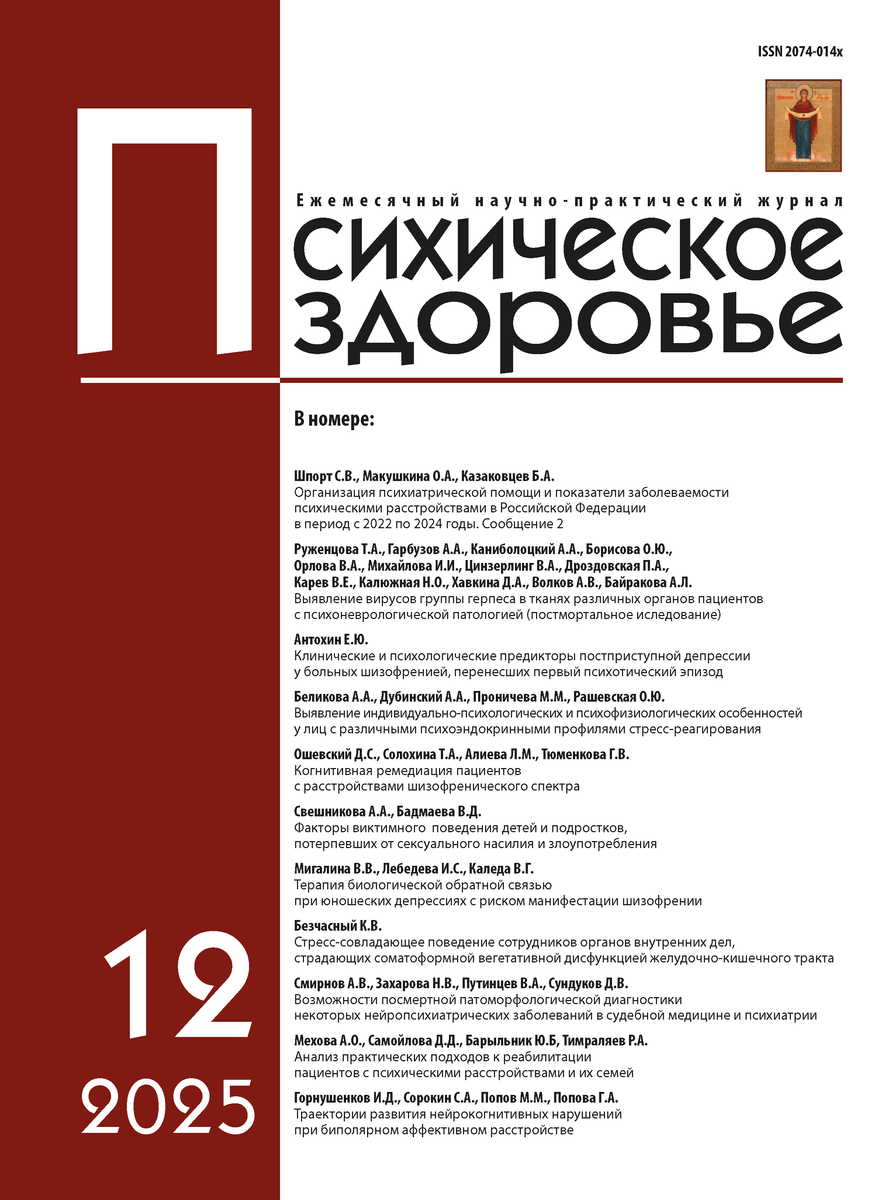
Published issue
Mental Health. 2025; Volume 20. Issue 12
- Volume
- 20
- Articles
- 11
- Archive format
- Bibliographic information
Full-text articles and issue PDFs are not hosted on this website.
Issue contents
Contents
Организационно-методологические аспекты
Organization of psychiatric care and incidence rates of mental disorders in the Russian Federation in the period from 2022 to 2024. Report 2
- National Medical Research Center of Psychiatry and Narcology n.a. V.P. SerbskyMoscow, Russia
Abstract
The article analyzes data from the state statistical observation for the period from 2022 to 2024. It presents indicators of the psychiatric service’s activities in the Russian Federation, confirming the need for further improvement of specialized care, including measures aimed at enhancing the quality of life and social adaptation of patients, preventing disability and other adverse consequences of mental disorders, and deinstitutionalizing the psychiatric service by developing hospital-substituting technologies. The article emphasizes the importance of achieving an optimal balance between medication, psychosocial therapy, and rehabilitation. It has been shown that multidisciplinary assistance using psychological correction methods and social support increases the effectiveness of psychopharmacotherapy, promotes readaptation, and restores work and communication skills. This algorithm of actions is considered an effective way to reduce the number of repeated hospitalizations.
Keywords: organisation of psychiatric care, psychiatric service, mental and behavioural disorders, patient populations registered with the psychiatric service, inpatient treatment, activity monitoring
For citation: Shport S.V., Makushkina O.A., Kazakovtsev B.A. Organization of psychiatric care and incidence rates of mental disorders in the Russian Federation in the period from 2022 to 2024. Report 2. Psikhicheskoe zdorovie [Mental Health]. 2025; 20(12): 3-10. (In Russian).
Clinical practice. Diagnosis. Treatment
Detection of herpes viruses in the tissues of various organs of patients with neuropsychiatric pathology (postmortem examination)
- Moscow Medical University «Reaviz»Moscow, Russia
- G.N. Gabrichevsky Research Institute for Epidemiology and MicrobiologyMoscow, Russia
- N.V. Sklifosovsky Research Institute for Emergency MedicineMoscow, Russia
- I.I. Mechnikov Research Institute of Vaccines and SeraMoscow, Russia
- V.A. Almazov Federal Research Center for Medical and Surgical SciencesSaint Petersburg, Russia
- I.I. Mechnikov North-Western State Medical UniversitySaint Petersburg, Russia
- S.P. Botkin Clinical Infectious Diseases HospitalSaint Petersburg, Russia
- National Clinical Center for Infectious DiseasesSaint Petersburg, Russia
- Russian University of MedicineMoscow, Russia
- The Research Institute for Healthcare Organization and Medical ManagementMoscow, Russia
Abstract
Aim: to determine the detectability of herpes viruses in various organs in patients with neuropsychiatric pathology.
Methods. The study included 42 deceased patients. The main group 1 included 15 patients with diagnosed parkinsonism (primary or unknown origin) (G20 according to ICD-10). The main group 2 included 15 patients with psychiatric pathology. The comparison group included 12 patients who had no history of Parkinsonism or psychiatric pathology. The material was studied by PCR for the presence of DNA from herpes simplex viruses’ types 1 and 2, herpes Zoster, Epstein-Barr, cytomegalovirus and human herpes virus type 6. The method of immunohistochemistry was used to verify positive cases. 210 samples of different tissues were examined: heart, brain, liver, kidneys, lungs.
Results. Viruses were most often detected among patients with schizophrenia and hallucinations: HCV-6 DNA was detected in 29 samples (39%) obtained from 13 patients (87%), CMV DNA was detected in 7 (47%) patients in 11 samples (15%), EBV – in 5 patients (33%) in 10 samples (13%), more often in kidney samples. CMV and EBV were found in the brain only among patients with Parkinsonism, schizophrenia, and hallucinations. The positive PCR results were confirmed by immunohistochemistry.
Conclusions. Among patients with schizophrenia and hallucinations, HCG-6 DNA was detected in organs more often than in Parkinsonism and in the absence of this pathology. Among patients with Parkinsonism, schizophrenia, and hallucinations, CMV DNA was found more often than in the absence of this pathology. In patients with schizophrenia and hallucinosis, herpesviruses are most often found in the kidneys. CMV and EBV were found in the brain only among patients with Parkinsonism, schizophrenia, and hallucinations.
Keywords: сytomegalovirus, herpes, herpesvirus infection, HHV-6, parkinsonism, Parkinson’s disease, PCR, schizophrenia, virus Epstein-Barr
For citation: Ruzhentsova T.A., Garbuzov A.A., Kanibolotsky A.A., Borisova O.Y., Orlova V.A., Mikhailova I.I., Tsinserling V.A., Drozdovskaya P.A., Karev V.E., Kalyuzhnaya N.O., Khavkina D.A., Volkov A.V., Bayrakova A.L. Detection of herpes viruses in the tissues of various organs of patients with neuropsychiatric pathology (postmortem examination). Mental Health [Psikhicheskoe zdorovie]. 2025; 20(12): 11-22. (In Russian).
Clinical and psychological predictors of post-scent depression in patients with schizophrenia who have experienced the first psychotic episode
- Orenburg State Medical UniversityOrenburg, Russian Federation
Abstract
Introduction. The prevalence of post-attack depression in schizophrenia is quite high and reaches up to 50% in patients who have suffered a first psychotic episode (FPE). Identification of clinical and psychological predictors of post-attack depression (PАD) in patients with schizophrenia who have undergone FPE determines a more accurate diagnosis of the patient’s mental state, and the determination of the target of centered tactics of his psychotherapy.
Objective: to determine clinical and psychological predictors of post-attack depression in patients with schizophrenia who have suffered a first psychotic episode based on multidimensional diagnostics, including clinical-psychopathological, psychometric and experimental psychological studies, both from the point of view of an objective assessment by a specialist and from the point of view of the patient himself.
Мethods. In several stages, using the criteria for inclusion, non-inclusion and exclusion from the group of 1112 patients who underwent FPE, a study sample of 243 patients with post-attack depression was formed. Psychometric methods for assessing symptoms were used: objective assessment by a specialist PANSS and CDSS, subjective assessment by the patient SCL-90R. In psychological diagnostics, questionnaires were used to assess the coping structure (SVF-120), perfectionism, and self-stigmatization. Statistical analysis was carried out using the linear regression method.
Results. Taking into account objective and subjective assessment, clinical and psychological predictors of PAD were determined. In an objective assessment by a specialist, 13 predictors are included in the regression equation, including 8 clinical and 5 psychological; in a subjective assessment by a patient, 9 predictors are identified, 5 clinical and 4 psychological.
Conclusions. The identified clinical and psychological predictors of PAD in patients with schizophrenia who have suffered a FPE determine the importance of psychosocial measures with their sufficient dosage, clear phasing, and complexity with the involvement of a multiprofessional team. The presence of psychological predictors in the diagnostic predictors performed by a psychiatrist determines their importance for establishing a diagnosis, despite the presence in the diagnostic criteria of the current classifications of predominantly clinical criteria. In contrast to psychological predictors in patients where manifestations of perfectionism are significant, during an objective examination by a specialist, the leading role is played by coping «reducing the severity of the problem through comparison with others», «avoidance tendencies» (inverse relationship), as well as «denial of guilt» (direct relationship). This point of view confirms the concept of coping, which, regardless of the degree of adaptability, performs a basic protective function.
Keywords: post-episode depression, first psychotic episode, clinical and psychological predictors
For citation: Antokhin E.Yu. Clinical and psychological predictors of post-scent depression in patients with schizophrenia who have experienced the first psychotic episode. Mental Health [Psikhicheskoe zdorovie]. 2025; 20(12): 23-29. (In Russian).
Individual psychological and psychophysiological features in individuals with different psychoendocrine stress response profiles
- V.P. Serbsky National Medical Research Center of Psychiatry and NarcologyMoscow, Russia
Abstract
Introduction. The article is devoted to the identification of individual psychological and psychophysiological characteristics in individuals with various psychoendocrine profiles of stress response. In the context of modern socio-economic progress, the problem of assessing stress resistance and timely diagnosis of stress-induced disorders is becoming an urgent task for medicine and psychology.
Methods. The study was conducted on a sample of 168 people, including employees of law enforcement agencies and civilian professions, with modeling of stressful situations, registration of psychophysiological indicators and assessment of changes in the levels of cortisol and dehydroepiandrosterone (DHEA) in saliva before and after stress. A psychodiagnostic complex aimed at studying individual psychological characteristics was also used.
Results and discussion. The study identified three psychoendocrine stress response profiles: adaptive (increased DHEA), maladaptive (decreased DHEA), and non-adaptive (low DHEA level with its decrease after stress), and also revealed significant differences between individual psychological and psychophysiological characteristics in these profiles. The obtained results associated with changes in the DHEA level allow to consider it as a biological marker of the body’s ability to adapt to stressful situations. The following characteristics were identified depending on the type of psychoendocrine stress response profile. The non-adaptive profile is characterized by a reduced level of behavioral self-control, difficulties in restraining the affect of irritation, a tendency to make quick and ill-considered decisions, and a desire to attract attention. The maladaptive profile, with depleted adaptive reserves, is characterized by high levels of self-control and rationality, high power of the beta rhythm in the upper range of the EEG. The adaptive profile is characterized by moderate confrontation as a coping strategy and low-frequency heart rate (LF) activity before stress modeling.
Conclusion. The obtained results on determining the influence of stress factors on changes in hormonal profiles can improve the accuracy of diagnosis and the effectiveness of personalized strategies for the prevention and correction of stress-induced disorders.
Keywords: hormonal profile, individual-psychological characteristics, psychophysiological characteristics, stress response
For citation: Belikova A.A., Dubinsky A.A., Pronicheva M.M., Rashevskaya O.Yu. Identification of individual psychological and psychophysiological features in individuals with different psychoendocrine stress response profiles. Mental Health [Psikhicheskoe zdorovie]. 2025; 20(12): 30-38. (In Russian).
Medical and social aspects
Cognitive remediation for patients with schizophrenia spectrum disorders
- Mental Health Research CentreMoscow, Russia
Abstract
Introduction. Neurocognitive deficit (NCD) – a decline in intellectual abilities (memory, attention, information processing speed, executive functions, etc.) – in patients with schizophrenia spectrum disorders (SSDs) that not only leads to unfavorable clinical outcomes but also negatively impacts personal and social functioning. Occurring in the early stages of the disease, it worsens as it progresses and persists even during remission. Therefore, studying the impact of psychosocial treatment and rehabilitation on ameliorating NCDs is a pressing issue.
Objective: to develop a comprehensive cognitive remediation program for long-term patients with SSDs and evaluate its effectiveness.
Methods. Nineteen patients with SSDs (ICD-10 F20.xxx, F21.xxx) at late stages of the disease (disease duration greater than 5 years) participated in this longitudinal experimental study (with triplicate measurements). In addition to the psychopathological method, psychometric tests and the PANSS and BACS scales were used. A comprehensive remediation program was developed and implemented, including psychoeducation, neurocognitive, and metacognitive training. Statistical methods were used to evaluate its effectiveness.
Results. Neurocognitive deficits were identified in patients with RSS at late stages of the disease. Participants demonstrated a high level of activity during the remediation program. Clinical and psychometric data showed that, compared to the initial state, patients significantly decreased their anxiety (p=0.0002) and tension (p=0.001), they also demonstrated a decrease in hypochondriacal (p=0.0001) and depressive tendencies, improved communicative competence (p=0.002), stabilized volitional processes (p=0.0003), and improved active attention (p=0.0005) and abstract thinking (p=0.004). Statistically, significant improvements were recorded in verbal (p=0.003) and working memory (p=0.05), speech function (p=0.002), and problem-solving ability (p=0.013). It was reflected in a significant increase in the composite score for neurocognitive processes (p=0.001).
Conclusion. This study demonstrated that cognitive remediation can alleviate cognitive dysfunction in long-term patients with cerebral ischemia. However, to maintain the effect, such interventions must be included in comprehensive psychosocial rehabilitation programs. These programs may include stress management training, adaptive coping strategies, self-regulation skills, compliance therapy, and other interventions.
Keywords: neurocognitive deficit, schizophrenia spectrum disorders, neurocognitive training, metacognitive training, psychosocial rehabilitation
For citation: Oshevsky D.S., Solokhina T.A., Alieva L.M., Tyumenkova G.V. Cognitive remediation of patients with schizophrenia spectrum disorders. Mental Health [Psikhicheskoe zdorovie]. 2025; 20(12): 39-49. (In Russian).
Factors of victim behavior of children and adolescents who have become victims of sexual violence and abuse
- A.V. Snezhnevsky Kostroma Regional Psychiatric HospitalKostroma, Russia
- V.P. Serbsky National Medical Research Centre for Psychiatry and NarcologyMoscow, Russia
Abstract
Introduction. Victim behavior of children and adolescents is a pressing social problem due to the significant increase in the number of criminal acts committed against them in recent years. In this study the authors set the goal of determining the relationship between psychopathological, ontogenetic, gender and socio-environmental factors with victim behavior of minor victims in situations of sexual violence and abuse.
Methods. The article presents the intermediate results of a comprehensive psychological and psychiatric examination of 152 minors – victims of sexual violence and abuse. The entire sample is divided into 2 groups depending on the duration and repetition of sexual violence. The study used clinical and psychopathological methods with a dynamic assessment of the mental state of the victims, experimental psychological, sexological and statistical methods using Statistica SPSS12 software.
Results. In the studied samples girls prevailed (81.25% in group 1 and 90.3% in group 2) in the gender ratio. Mental disorders were detected in almost half of the subjects (43.8% and 51.3%, respectively). Comparative analysis of the groups by significant parameters showed that in terms of the impact on the victim behavior of the victims, social and environmental factors had a high relationship with individual psychological characteristics (in 62% and 55.1%, respectively). Personality characteristics in correlation with the identified mental disorder were significant in the behavior of the subjects in 43.7% and 36% (respectively). The correlation between manifestations of sexual dysontogenesis with and psychopathological factor was 40% in both groups.
Discussion. The obtained data showed that both groups demonstrated comparability in a number of factors. The victimization of children and adolescents in the situation of sexual offenses committed against them was significantly influenced by their individual psychological characteristics and socio-environmental factors. The victims demonstrated predominantly a passive-submissive type of victim behavior.
Conclusions. Victim behavior of victims is associated with a combination of objective, subjective and situational factors of victimization. The influence and contribution of each of them on the behavior of an adolescent victim in a situation of committing a crime and the implementation of the entire range of procedural actions is multifaceted, which in the long term dictates the need to expand the scope of research.
Keywords: victimization, victim behavior, dysontogenesis, adolescents, victims, sexual violence and abuse
For citation: Sveshnikova A.A., Badmaeva V.D. Factors of victimization behavior of children and adolescents who suffered from sexual violence and abuse. Psikhicheskoe zdorovie [Mental Health] 2025; 20(12): 50-59.
Brief report
Biofeedback therapy for juvenile depression with risk of schizophrenia development
- Research Center for Mental HealthMoscow, Russia
Abstract
Introduction. Juvenile depression with attenuated symptoms of schizophrenia (ADS) represents a distinct clinical group with a poor prognosis, high treatment resistance, and the risk of developing endogenous psychosis. In recent years, interest in complementary treatment methods, including biofeedback therapy (BFB), has increased. However, the stage at which BFB is most effective in the course of depression remains unclear. This study aims to determine the optimal time to initiate BFB and identify key psychopathological targets for its application.
Objective: to identify indications and key psychopathological targets for biofeedback therapy (BFB) for juvenile depression with attenuated schizophrenia symptoms.
Methods. Sixty-two adolescent male patients (mean age 20.4 ± 2.3 years) hospitalized for the first time at the Scientific Center for Mental Health (SCMH) for a depressive episode (ICD-10: F21 – 25 patients, F32–34 – 35 patients) were examined. Patients were divided into two groups: Group 1 (n=32) received BFB during the acute phase during the first week of hospitalization, while Group 2 (n=30) received BFB during the partial symptom reduction phase (with a HDRS reduction of ≥30%). All patients underwent 8–15 BFB sessions. Assessment was performed using the HDRS, SOPS, and SANS scales.
Results. Both groups showed a significant reduction in the severity of depression, prodromal, and negative symptoms (p<0.05). However, the degree of reduction was higher in patients who were prescribed biofeedback during the reduction phase: HDRS – 78.5%, SANS – 56.7%, SOPS – 59.6% versus 50.1%, 33.6%, and 36.7%, respectively (p<0.05).
Conclusion. The optimal time for biofeedback administration is the stage of partial symptom reduction. Application during the acute phase is less effective and is associated with the risk of worsening non-affective symptoms. A promising direction is the study of the maintenance use of biofeedback in the post-hospital period.
Keywords: juvenile depression, biofeedback, attenuated symptoms of schizophrenia, prodromal symptoms, negative symptoms
For citation: Migalina V.V., Lebedeva I.S., Kaleda V.G. Biofeedback therapy for juvenile depression at risk of schizophrenia onset. Psikhicheskoe zdorovie [Mental Health]. 2025; 20(12): 60-65. (In Russian).
Stress-coping behavior among police officers suffering from somatoform vegetative dysfunction of the gastrointestinal tract
- Medical Department of the Ministry of Internal Affairs of Russia across MoscowMoscow, Russia
Abstract
In order to identify the structural and dynamic characteristics of the protective and coping response and the nature of the effects of asthenia, depression and anxiety, 108 police officers were examined, who were diagnosed with somatoform autonomic dysfunction of the gastrointestinal tract in accordance with the criteria of ICD-10 (F. 45.3).The study revealed and showed that the differences are both purely individual in nature and cross-cutting, reflecting a pronounced intrapersonal conflict. This indicates the weakness of the protection system for police officers suffering from somatoform autonomic dysfunction of the gastrointestinal tract, regardless of gender, emphasizing their low adaptive capabilities, making it difficult to understand the problems. Constant internal tension associated with conflictogenic attitudes contributes to the formation of a stable stereotype of behavior and the style of adaptive response in conditions of stress-coping behavior. The features of the course of somatoform pathology, the qualitative uniqueness of its interrelationships with personal characteristics are the key to understanding the prognostic value of the formed compensatory and adaptive mechanisms, which significantly increases the effectiveness of medical support programs for police officers suffering from borderline mental pathology and timely provision of qualified medical and preventive care. The results of the study are proposed to be used in psychohygienic work with employees who are prone to somatoform reactions in conditions of duty, which will contribute to their professional success.
Keywords: somatoform vegetative dysfunctions, coping behavior strategies, mechanisms of protective response, police officers
For citation: Bezchasniy K.V. Stress-coping behavior among police officers suffering from somatoform vegetative dysfunction of the gastrointestinal tract. Mental Health [Psihicheskoe zdorovie]. 2025; 20(12): 66-72. (In Russian).
Review
Possibilities of postmortem pathomorphological diagnosis of certain neuropsychiatric disorders in forensic medicine and psychiatry
- ФГАОУ ВО «Московский государственный юридический университет имени О.Е. Кутафина»Москва, Россия
- ФГАОУ ВО «Российский университет дружбы народов имени Патриса Лумумбы»Москва, Россия
- Научно-исследовательский институт морфологии человека им. акад. А.П. Авцына,ГНЦ РФ ФГБНУ «Российский научный центр хирургии им. акад. Б.В. ПетровскогоМосква, Россия
Abstract
Introduction. In civil proceedings involving the contestation of legal transactions, it is often necessary to determine the mental state of a deceased person during a legally significant period. Postmortem forensic psychiatric examination (FPE), conducted based on case materials and medical documentation, is complicated by the absence of direct clinical assessment. Pathomorphological examination of the brain provides additional opportunities for objective diagnosis of mental disorders, increasing the reliability of expert conclusions.
Aim. To systematize data on morphological alterations of the brain in mental disorders of forensic psychiatric significance, including schizophrenia, bipolar affective disorder, and dementias of various etiologies.
Methods. A review of Russian and international publications on brain pathomorphology was conducted, with reference to neuroimaging, histological, and immunohistochemical studies.
Results. Schizophrenia is associated with ventricular enlargement, gray matter atrophy, neuronal migration abnormalities, and oligodendrocyte pathology; bipolar affective disorder demonstrates reduced neuronal and glial density, cortical thinning, and signs of oxidative stress; dementias show senile plaques, neurofibrillary tangles, and gliosis as key morphological features.
Conclusion. Pathomorphological findings significantly enhance the diagnostic and interpretative capacity of comprehensive postmortem forensic psychiatric examinations, contributing to an objective evaluation of mental disorders and their impact on legal capacity and decision-making.
Keywords: postmortem forensic psychiatric examination, brain pathomorphology, schizophrenia, bipolar affective disorder, dementia, neuropathology, forensic medicine
For citation: Smirnov A.V., Zakharova N.V., Putintsev V.A., Sundukov D.V. Possibilities of postmortem pathomorphological diagnosis of certain neuropsychiatric disorders in forensic medicine and psychiatry. Mental Health [Psikhicheskoe zdorovie]. 2025; 20(12): 73-82. (In Russian).
Analysis of practical approaches to the rehabilitation of patients with mental disorders and their families
- Saratov State Medical University named after V.I. RazumovskySaratov, Russia
Abstract
Introduction. Educational work with patients’ families is necessary to reduce the number of rehospitalizations and conflicts within the family, promptly recognize symptoms of the disease, and understand treatment methods. Currently, there are no unified clinical guidelines outlining standards for rehabilitation interventions. There is no unified system for evaluating the effectiveness of psychosocial rehabilitation. Patients’ relatives remain untrustworthy of treatment in psychiatric inpatient facilities. There is a lack of coordination between psychiatric hospitals, outpatient clinics, public and social organizations, and the government.
Methods. A review of the scientific literature.
Results. An analysis of the study of largest psychiatric institutions providing rehabilitation care to patients with mental disorders and their families in the Russian Federation highlights the relevance and need for further development of this approach and its systematic implementation by psychiatric specialists.
Keywords: mental disorder, rehabilitation, psychoeducation, first-episode psychosis unit, patient families, schizophrenia
For citation: Mekhova A.O., Samoylova D.D., Barylnik Yu.B., Timralyaev R.A. Analysis of practical approaches to the rehabilitation of patients with mental disorders and their families. Mental Health [Psikhicheskoe zdorovie]. 2025; 20(12): 83-88. (In Russian).
Trajectories of neurocognitive impairment in bipolar affective disorder
- Scientific Center for Mental HealthMoscow, Russia
Abstract
Introduction. This publication is a narrative review of the literature on the topic of possible trajectories of neurocognitive impairments in bipolar affective disorder (BD). The problem of heterogeneity of cognitive impairments in BD, modern concepts of BD subtypes from the point of view of neurocognitive functioning, data from longitudinal studies with an overview of their possible trajectories of development are discussed.
Objective: to present a narrative review of the literature on the problem of trajectories of development of neurocognitive impairments in BD.
Methods. By searching the scientific databases «PubMed» and «Google Scholar» by combinations of keywords «bipolar disorder», «neurocognitive», «trajectory» were selected publications corresponding to the purpose of the study.
Results. By means of cluster analysis in modern studies, three groups of patients are distinguished – relatively preserved, with neurocognitive deficits of moderate and severe severity. These groups differ in the clinical parameters of the disease among the patients included in them. Longitudinal and meta-analytical studies of recent decades show the absence of significant dynamics for the worse, relative stability of neurocognitive deficits in bipolar disorder (even when considering the three groups of patients under discussion separately).
Conclusion. The data obtained argue against the hypothesis of a progressive, degenerative nature of cognitive impairment in bipolar disorder. At the same time, clinical parameters of the disease, apparently, do not have a significant impact on the severity of cognitive deficit, although this information requires further clarification.
Keywords: impulsivity, personality disorders, BPD, neurocognitive impairment
For citation: Gornushenkov I.D., Sorokin S.A., Popov M.M., Popova G.A. Trajectories of neurocognitive impairment in bipolar affective disorder. Mental Health [Psikhicheskoe zdorovie]. 2025; 20(12): 88-93. (In Russian).